

Views: 0
Five stars can easily catch the eye. People notice the rating first. But trust is what wins the customer because people trust what real customers say. That is why a strong Google Review UK strategy matters. Real reviews can help your local ranking. They also help customers decide if they trust your business before they buy. Real reviews show what customers truly think about your service. However, paid or fake reviews can damage that trust. UK rules now ban key fake-review practices.
So the goal is not simply getting more stars. It is building honest reviews that support trust, visibility and long-term growth.
Now let’s dive into what really matters for your Google reviews, what to avoid and how to build trust the right way.
What Should a Google Review UK Strategy Focus On?
A good Google Review UK strategy should focus on real trust, easy access and steady review growth. It should not chase a fixed review number. Google says local results depend on relevance, distance and local standing. Reviews can support local standing, but they do not guarantee a top place.
In practice, a healthy profile needs four things:
- Real reviews: Reviews should come from people who really used your business.
- Steady growth: Ask for feedback as part of normal customer care.
- Easy access: Make reviews easy with a direct link or QR code.
- Trust: Let customers explain their own experience in their own words.
But why does this matter? A page full of empty five-star comments can feel weak. Real reviews often mention service, value, timing or how staff handled a problem. Those details help new customers judge the business.
Basically, do not look at the star score alone. Check review numbers, review quality and recent feedback. Also check how your team replies. Together, these signs show whether the profile feels real.
Is Buying Google Reviews in the UK Legal or Allowed?
Buying Google reviews in the UK can bring two types of risk. One comes from Google’s rules. The other comes from UK law. Google does not allow paid reviews that pretend to be from real customers. UK law also bans key fake-review practices. So, a review service can look professional but still cause problems for the business.
What Do Paid Google Review Services Usually Promise?
People who search for “buy Google reviews UK” often see the same sales claims. Sellers may promise UK accounts, custom text and slow delivery. They may also offer replacement cover. Those features can sound safer, but they do not prove a real customer visit.
Common promises often look like this:
- UK targeting: The seller says reviewers come from UK areas.
- Custom wording: Reviews can mention chosen products or services.
- Gradual delivery: Reviews appear across days or weeks.
- Established accounts: Sellers may offer older-looking reviewer accounts.
- Replacement cover: Some replace reviews that Google removes.
In fact, these are seller features, not proof of a real experience. An old account can still post a false review. In the same way, slow delivery does not turn fake feedback into real feedback.
Google requires reviews to reflect real experiences. Paid reviews can count as fake engagement. So buying Google reviews is not safe just because the posts look natural.
What Do Google Policy and UK Law Say?
Google does not allow paid reviews or rewards for reviews. This includes money, free items, discounts and free services. Businesses should also not ask customers for a set star rating or exact words. UK law also has rules about fake reviews. These new rules started on 6 April 2025. Businesses must not write or pay for fake reviews. They must also be careful with paid or rewarded reviews that are not made clear.
Using an agency does not remove the risk. The CMA says businesses should not pay third parties to write fake reviews. A business can still be liable for an agency’s actions. This also applies to PR, marketing and SEO work.
The risk can be serious. The CMA says some breaches can lead to large fines. In some cases, the fine can reach 10% of global turnover. Criminal action can also apply in some cases.
The UK has also pushed Google to act harder on fake reviews. In January 2025, Google gave formal promises to the CMA. These cover stronger checks, sanctions and warning alerts for fake-review abuse.
For this reason, can I pay to get google reviews UK law and Google review policy should be checked together. One does not replace the other. A paid review can break Google’s rules even if the seller calls it safe.
What Can Happen If You Buy Reviews for Google?
If you buy reviews for Google, the risk goes beyond losing a few comments. Google can act against the reviews and the Google Business Profile. UK law can also apply. A review staying live today does not prove it is safe or permanent.
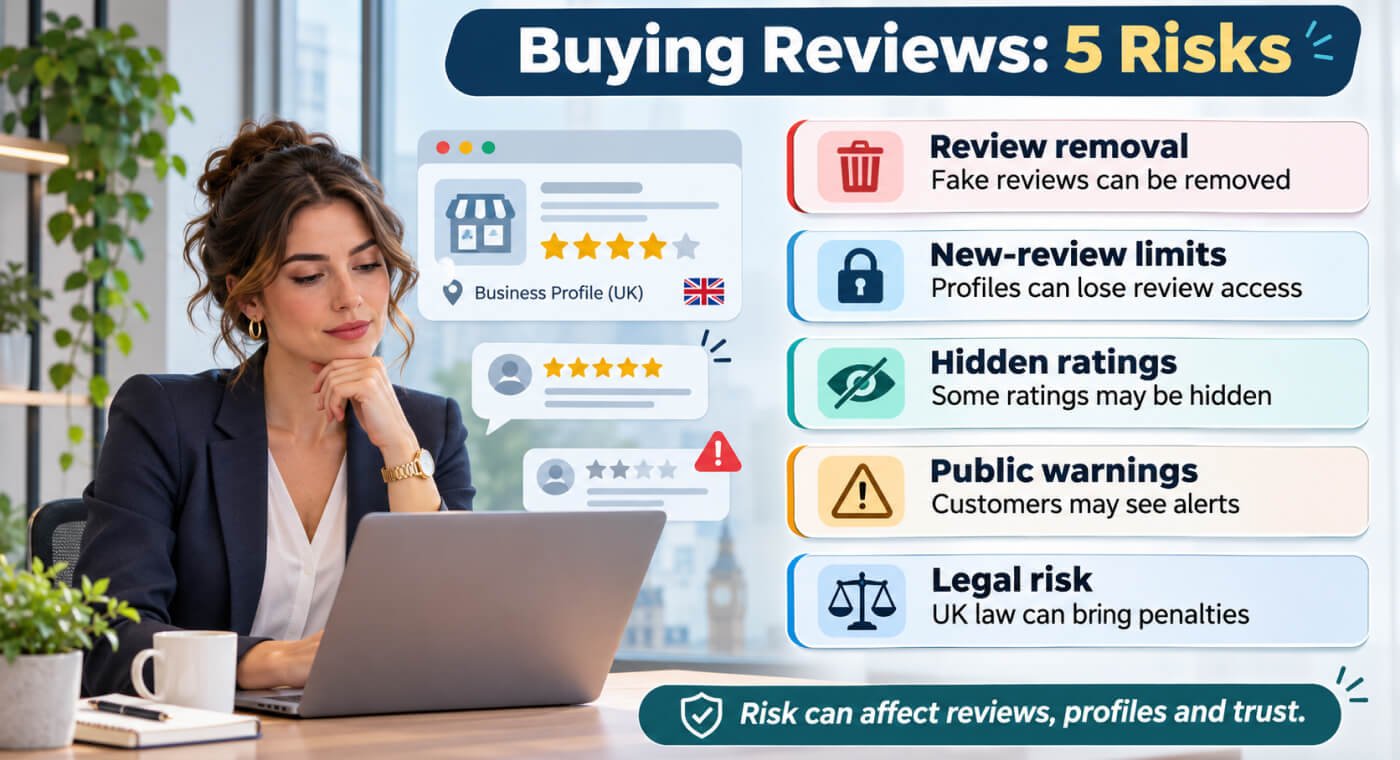
Businesses should understand five main risks:
- Review removal: Google can remove reviews that break its rules.
- New-review limits: A profile can lose new-review access for a time.
- Hidden ratings: Google can hide some ratings or reviews for a period.
- Public warnings: Customers can see alerts about fake-review activity.
- Legal risk: UK law can create separate action or penalties.
The CMA secured stronger fake-review action from Google in 2025. Google agreed to sanction firms that use fake reviews. It also agreed to warn UK users about suspicious review activity.
So what does this mean in practice? A seller can replace one removed review. That does not protect the whole profile. It also does not remove legal risk or lost customer trust. In the same way, UK accounts, slow posting and custom text do not prove a review is real. The key question stays the same. Did the reviewer really use the business?
How to Get Google Review UK Without Buying Them?
How to buy Google reviews in the UK safely is simple in principle. Ask real customers after a real experience. Make the review route easy. Then build the request into normal customer care. This creates genuine Google reviews without using paid shortcuts.
When and Where Should You Ask Customers for Google Reviews?
Ask after the customer has had enough time to judge your service. A trades-person can ask after the job ends. A clinic can ask after the visit. An online shop can ask after the order arrives.
A Google Review UK request works best when the customer can act quickly. Good places for a Google review link are easy to use. They should also fit naturally into the customer journey.
- Thank-you emails: Add one clear review request after the service.
- SMS or WhatsApp: Send the link while the experience is still fresh.
- Receipts or invoices: Give customers a quick route to the review page.
- Chat follow-ups: Share the link when support or service has ended.
- QR cards or displays: Use them where real customers can scan them.
Google lets businesses use a Google review QR code and direct review link. The QR code tool currently works through a computer browser. Customers must sign in to a Google Account before leaving a review. They do not need a Mail address.
But why is timing so important? A request sent too early can feel odd. A request sent months later can feel less relevant. In practice, ask while the service is still clear in the customer’s mind.
How Can You Turn Review Requests Into a Repeatable Process?
A clear review system works better than asking customers at random times. So, keep the process simple and fair for everyone. Ask real customers in the same way and do not choose only people who may praise you.
A simple flow can look like this: Customer experience → review request → genuine review → business reply → monthly review check.
Staff should know when to ask and where the link sits. They should also know what not to say. Never ask for five stars. Ask for an honest review instead.
Automation can help with steady review growth. A booking tool, CRM or email tool can send the request. However, the rule stays the same. The request should go to real customers in a fair way.
That is how to get Google Reviews UK without forcing the process. You build a steady system, not a short burst. Over time, that helps build lasting trust with real customers.
Which Google Review Tactics Can Quietly Break the Rules?
Some common tactics can break Google review policy without looking risky at first. Review gating, rewards and scripted feedback are key examples. Conflicted reviews can also cause trouble. The safest rule is simple: keep the process open, honest and tied to real customer use.
Five risky tactics stand out:
- Review gating: Do not ask only happy customers for public reviews.
- Rewards: Do not offer money, gifts, discounts or free services.
- Staff quotas: Do not force workers to collect a set number.
- Scripted feedback: Do not demand set words, ratings or staff names.
- Conflicted reviews: Be careful with staff, relatives and business partners.
But why can business links matter? A review should come from an independent customer view. Current or former staff can have a conflict. Family, partners, consultants or rivals can also create doubt.
In the same way, a rewarded review can still break Google’s rules, even when you say it was rewarded. Saying it clearly does not always make the review safe for Google Maps. So, avoid tricks that try to push customers towards a certain rating. Ask for honest feedback, not praise. This keeps the review process simple, fair and clear.
How Should You Manage Positive, Negative, Fake or Missing Google Reviews?
Good review management means knowing how to reply in each case. Thank customers for real positive reviews. Also, answer real complaints in a calm way. If a review clearly breaks the rules, report it. However, give Google time to check missing reviews before you think they were removed.
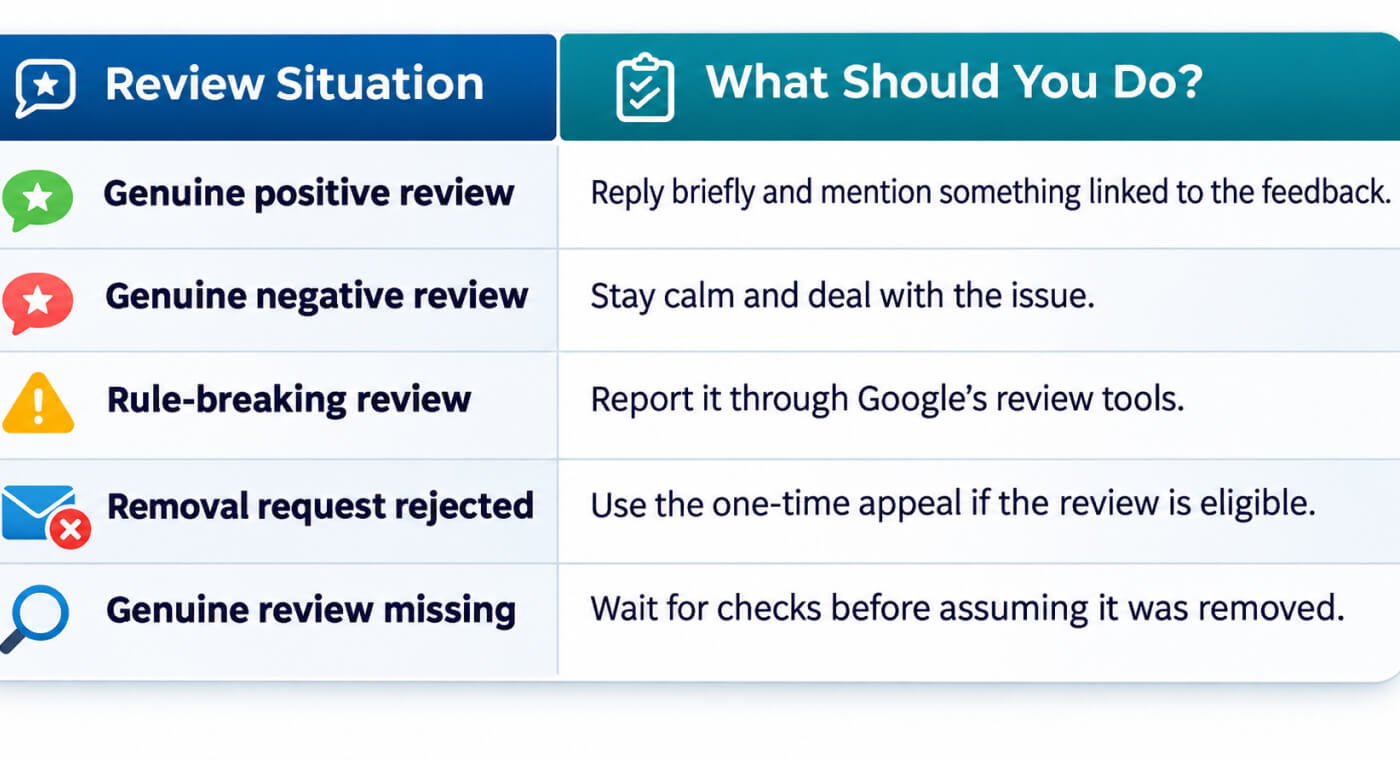
A bad rating is not proof of a fake review. Customers can have poor experiences and say so. So report a Google review only when it appears to break the rules.
If Google says no to your review removal request, you may be able to appeal. Keep clear records and explain which rule the review may have broken. Also, do not argue only because the review feels unfair.
But why do missing Google reviews happen? Some real reviews take time to show. Google may need time to check them. Profile changes or profile merges can also cause delays in Search and Maps.
In the same way, the star score may not change at once. Give the system time before assuming something went wrong. This keeps your response calm and based on facts.
When you reply to Google reviews, think about future readers too. Thank customers for real praise. Also, answer negative reviews in a calm way without blame or anger. Mainly, a calm and helpful reply can show how your business deals with problems.
What Should UK Businesses Know About Publishing Online Reviews?
UK businesses that publish online reviews have extra duties. They should take fair steps to stop fake reviews and misleading review data. Clear rules, checks and honest rating displays can help keep the page fair for customers.
The CMA says review publishers should take reasonable steps against fake reviews. They should also deal with hidden incentive’s reviews and false review data. This can cover review text, star scores, review counts and review summaries. The CMA also says businesses must not write or commission fake reviews. Its guidance applies to firms and agencies. That means review work should not become a hidden marketing trick.
In practice, do not hide real negative reviews just to raise your average score. Your review page should give customers a fair and honest picture. Good review care should build trust. Not just make the rating look better.
There is also an SEO point here. A business can show real reviews on its own website. However, its own review stars do not qualify for every Google rich result. So, use reviews to build trust, not as a shortcut for schema.
Final Thoughts: What Should Your Google Review UK Strategy Do Next?
A strong Google Review UK strategy should leave proof, not just a higher number. Every real review adds another customer voice to your reputation. Over time, those voices tell a story that paid ratings cannot copy.
The goal is not to look perfect. It is to look real, active and worth trusting. So make honest review requests part of your normal customer journey. Give people an easy link, then let them speak in their own words.
Think of your review profile as something you build, not something you fill. Genuine feedback keeps adding value as your business grows. That is the kind of reputation no shortcut can truly replace.
Most Common Questions About Google Review UK (FAQs)
1. How do I leave a Google review in the UK?
Go to Google Maps and use the search bar to find the business you want to review. Choose the business, open Reviews, select a star rating and write about your real experience. You need to sign in to a Google Account first.
2. How do I leave a review with Google?
Search for the business on Google Maps and open its profile. Then open the business reviews, pick your rating and describe your real experience.
3. How can I view my Google reviews?
Open Google Maps and go to Your profile or Your contributions. You can then see the reviews and ratings you have posted and edit or delete them if needed.
4. How do I review a business online?
Find the business on Google Maps while signed into your Google Account. Open its reviews, choose a star rating and describe your genuine experience with the business.
5. How do I leave a review for a company?
Search for the company on Google Maps and open its Business Profile. Select the review option, choose a rating and share clear feedback about your real experience.
6. How can I write a Google review for an online business?
You can leave a Google review when the business has an eligible Google Business Profile. Purely online businesses without face-to-face customer contact are generally not eligible for a Business Profile.
7. Can I leave a Google review for my own business?
You should not review your own business. Google requires reviews to be genuine and unbiased, and reviews linked to employment or other conflicts of interest can be removed.
