

Views: 0
A few extra five-star reviews can look like an easy win. But paid reviews can bring serious risks. Actually, the real difference is whether you pay for support or for a review. So, can I pay to get Google reviews? You can pay for tools that help real customers share honest feedback. Otherwise, paying for fake, rewarded, or made-up reviews can create problems.
Google treats paid reviews as fake engagement and can remove them. It can also place limits on your Business Profile. Similarly, UK consumer rules cover fake reviews and hidden paid reviews. The key point is simple. You can pay for a fair review process but not for the review itself.
Now, let’s see what actually counts as buying Google reviews in the UK.
Can I Pay to Get Google Reviews in the UK?
Yes, you can, say, for software or a service that collects honest customer reviews. However, you should not pay people to create Google reviews for your business. Rewards for posting reviews are also not allowed. Google treats paid or rewarded reviews as fake engagement. It can remove them and place limits on a Business Profile.
In practice, three things can happen. A seller might make reviews from people who never used your business. Real customers might get money, discounts or free items for posting a review. A review tool can also send a fair request after a real purchase. This can work if the request stays neutral and customers choose their own rating and words.
What Counts as Buying Google Reviews?
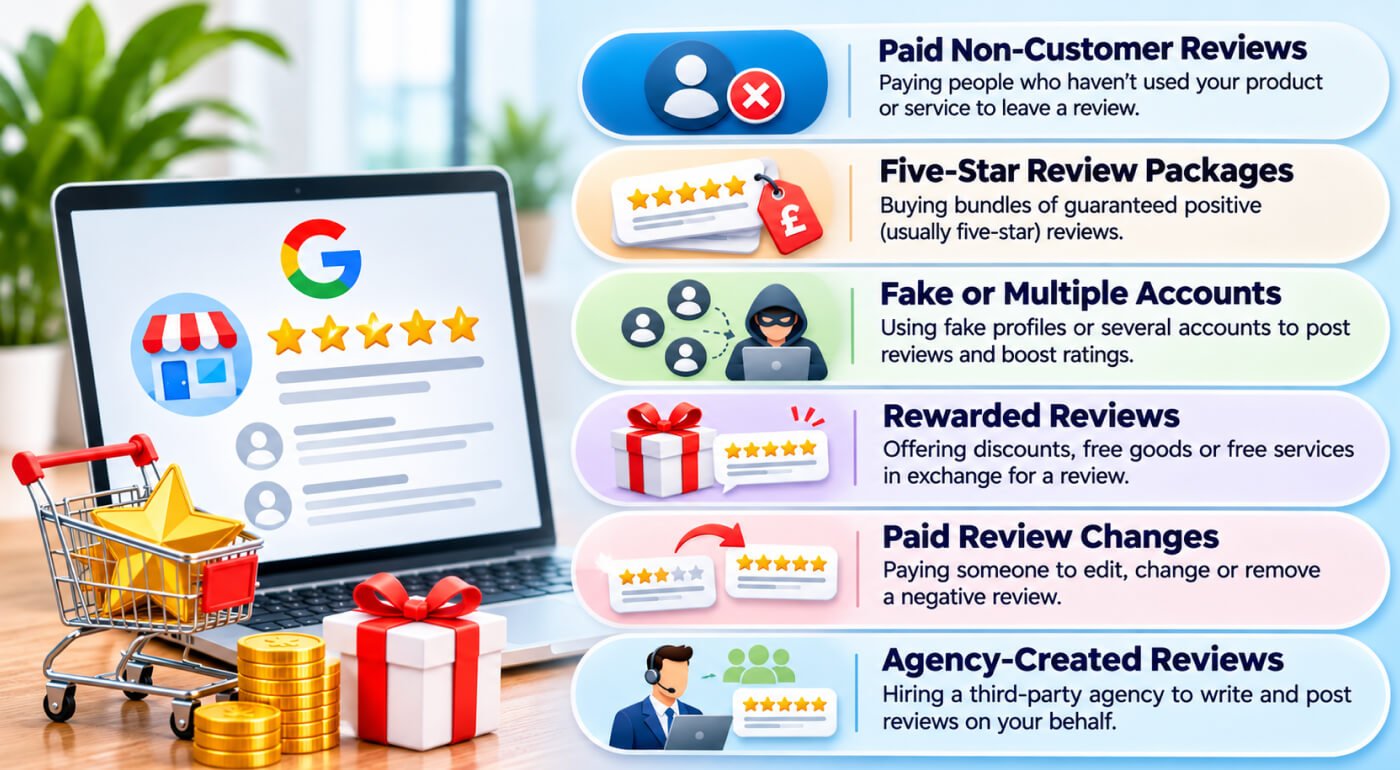
Buying Google reviews means paying for content or action designed to raise, change, or protect a rating. The payment does not need to be cash. Google also treats discounts, free goods and free services as rewards when they are exchanged for reviews. So buying reviews can take several forms, even when no money changes hands.
- Paid non-customer reviews: Someone posts feedback despite never using the business.
- Five-star review packages: A seller promises a fixed number of positive ratings.
- Fake or multiple accounts: Accounts are used mainly to push a rating up.
- Rewarded reviews: Customers get money, discounts, goods, or services for posting.
- Paid review changes: A reward pushes someone to edit or remove negative feedback.
- Agency-created reviews: A third party writes or arranges reviews instead of contacting real customers.
Generally, paying for review software is not the same as buying reviews. A good system can send requests, track replies and help staff respond. The customer must still write an honest review based on a real experience. That is the key line between review management and manipulation. A sales label does not change it.
Is Buying Google Reviews in the UK Illegal?
Yes, buying Google reviews in the UK can break consumer law if the reviews are fake or hide a reward. The current unfair trading rules started on 6 April 2025. They come under the Digital Markets, Competition and Consumers Act 2024, also called the DMCC Act. These rules cover fake reviews, hidden rewards and misleading review information.
UK law also bans paying another person to create fake consumer reviews. A business cannot avoid the issue by hiring another company. Paying a third party to create a banned review is covered too. So, third-party review packages can create a legal risk as well as a Google policy risk.
However, Google’s platform rules and UK consumer law do not use exactly the same test. Google bans rewards for Business Profile reviews on its platform. UK law focuses on fake reviews, hidden rewards and misleading review information. The CMA can enforce consumer law directly. For some breaches, the legal limit can reach £300,000 or 10% of worldwide turnover, whichever is higher.
Which Paid Review Tactics Break Google’s Rules?
Google says Google Maps and Business Profile reviews should reflect real customer experiences. Paid reviews, rewarded reviews and rating manipulation can break that rule. Basically, honest feedback must stay voluntary, genuine and free from pressure.
- Cash for a review: Paying someone directly for posting feedback.
- Discounts for reviews: Giving money off in return for a Google review.
- Free goods or services: Giving products, meals, stays, or services for reviews.
- Rewards for changes: Offering something for editing or removing a negative review.
- Non-customer reviews: Asking people who did not use the business to post.
- Multiple-account activity: Using several accounts to change a rating.
- Scripted praise: Asking reviewers to use fixed wording or name a staff member.
- Selective requests: Only asking people expected to leave positive feedback.
Google also tells businesses not to pressure customers on the premises. Staff should not get targets that push review numbers. A fair request asks for honest feedback. It does not tell the customer what score or words to use.
Is Review Gating Allowed on Google?
No, review gating is not allowed on Google. It means filtering customers before giving them a public review link. A business might ask whether someone was happy. Happy customers then reach Google, while unhappy customers get a private form. This can give the public a false picture.
So, what should you do instead? Give real customers the same fair chance to review your business. You can still deal with complaints in private. However, do not hide the public review route from unhappy customers. This keeps the review process fair and open.
What Can You Pay for Without Buying Google Reviews?
You can pay for help with the review process. But you should not pay for the review itself. This simple rule helps separate useful review support from fake engagement. Basically, the service should make feedback easier to collect without controlling the rating, words or customer view. The customer should still choose whether to leave a review and what to say.
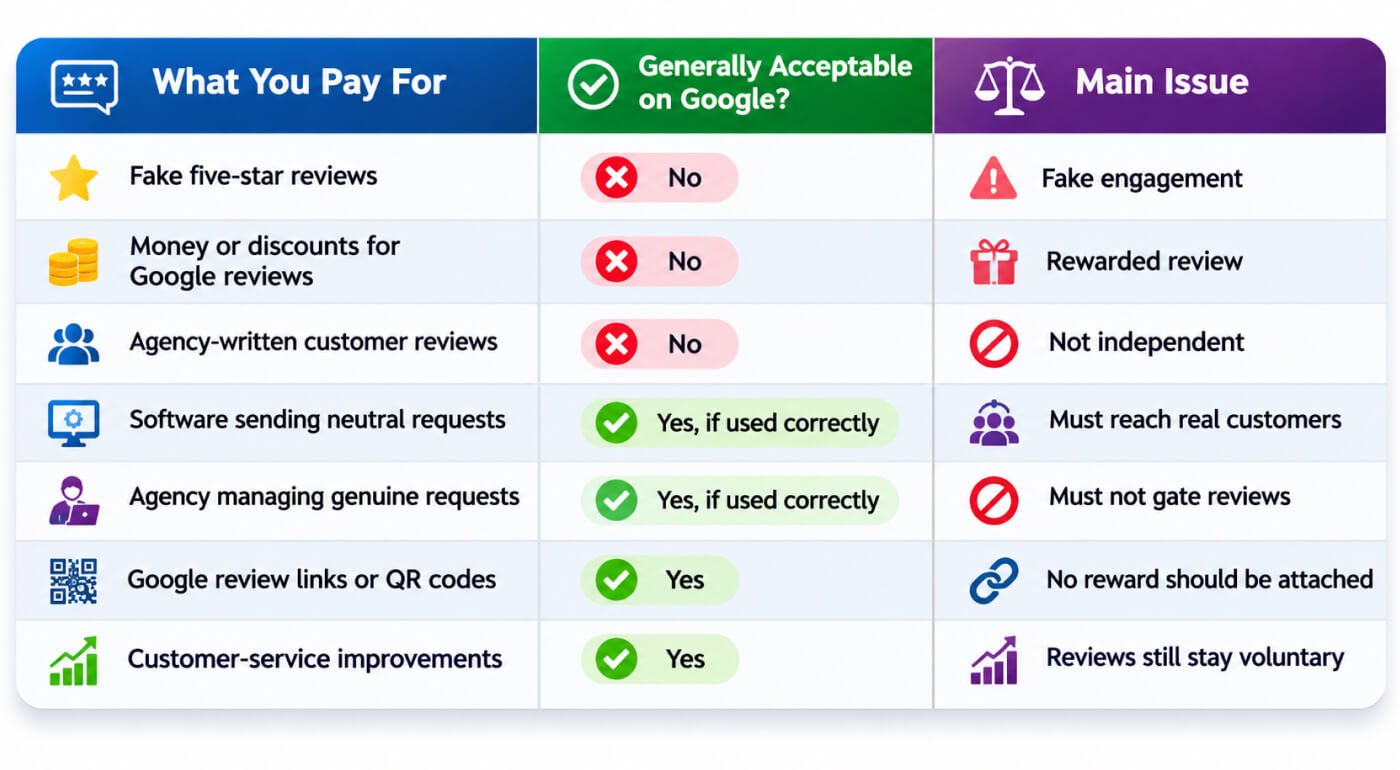
Google gives businesses direct review links and QR codes. A business can place them in a thank-you message, receipt, or completed chat. A review tool can send the link after a real purchase. The customer still chooses whether to review and what to say.
How Can You Check a Google Review Service Before Paying?
Check how the service gets its reviews before you pay. A trustworthy company should explain where the reviews come from. Vague answers are a warning sign. Ask whether it contacts your real customers. Also check who writes the reviews and whether unhappy customers get the same route.
Guaranteed five-star reviews should make you question the method. The same applies to promises of non-drop or permanent reviews. No outside seller controls Google’s systems. Also, keep ownership and control of your Business Profile when an agency needs access.
What Happens If Google Finds Fake or Incentive’s Reviews?
Google can remove reviews that break its fake engagement rules. It can also place limits on a Business Profile when it finds rule-breaking activity. The outcome depends on the case, so there is no single penalty for every business. Still, the possible effects can reach much further than losing a few bought reviews.
- Review removal: Fake, paid, or manipulated reviews can disappear.
- Review limits: A profile can lose the ability to receive new reviews for a period.
- Hidden ratings: Existing reviews or ratings can become hidden for a period.
- Profile warnings: Google can show a notice saying fake reviews were removed.
- Trust damage: Customers can become more cautious when they see warning signs.
There is also a UK-specific point. Google gave the CMA firm promises to strengthen action against fake reviews. UK businesses can get warning alerts and lose review functions. Repeat fake-review activity can lead to all reviews being deleted for six months or longer.
But why does that matter so much? Reviews often build slowly over years. A short-term attempt to raise a score can put that history at risk. Practically, the bigger loss can be the trust and genuine review history you already earned.
Can Google Detect Bought Reviews?
Yes, Google can detect some bought reviews. However, nobody outside Google knows exactly how its full system works. Google does share some signs that can point to fake activity. These can include unusual numbers of reviews, strange posting patterns, several accounts or activity made to look real.
So, can a seller promise that bought reviews will stay live? To be honest, there are no sellers who control Google’s systems. A review that stays today could still disappear later. In practice, many similar reviews posted at once can look less natural than steady customer feedback. That is why claims like non-drop or permanent reviews should be treated with care.
Do Bought Google Reviews Actually Help Local SEO?
No, bought Google reviews are not a safe way to improve local SEO. Reviews do matter for local search. However, Google does not rank businesses by review count alone. Its local ranking guidance focuses on relevance, distance and prominence. Review count and positive ratings can support prominence but they are only one part of the wider system.
Still, some businesses can feel tempted. A new company may have only five reviews while a rival has hundreds. Another business may want to improve after getting poor ratings. Buy reviews UK can seem like a quick fix. Actually, it can put the whole profile at risk just to change one visible signal.
How Many 5 Star Reviews Do You Need to Go Up on Google?
There is no fixed number of five-star reviews that guarantees a higher Google position. A useful target for one business might mean little for another. Local competition changes by place, search term, business type and nearby rivals. Google also says there is no way to request or pay for a better local ranking.
Generally, compare your review growth with the number of real customers you have. Do not chase a magic number. A busy restaurant and a small specialist service will not get reviews at the same speed. Steady and honest review growth matters more than a made-up target.
Why Can Fake Five-Star Reviews Hurt More Than Your Rating?
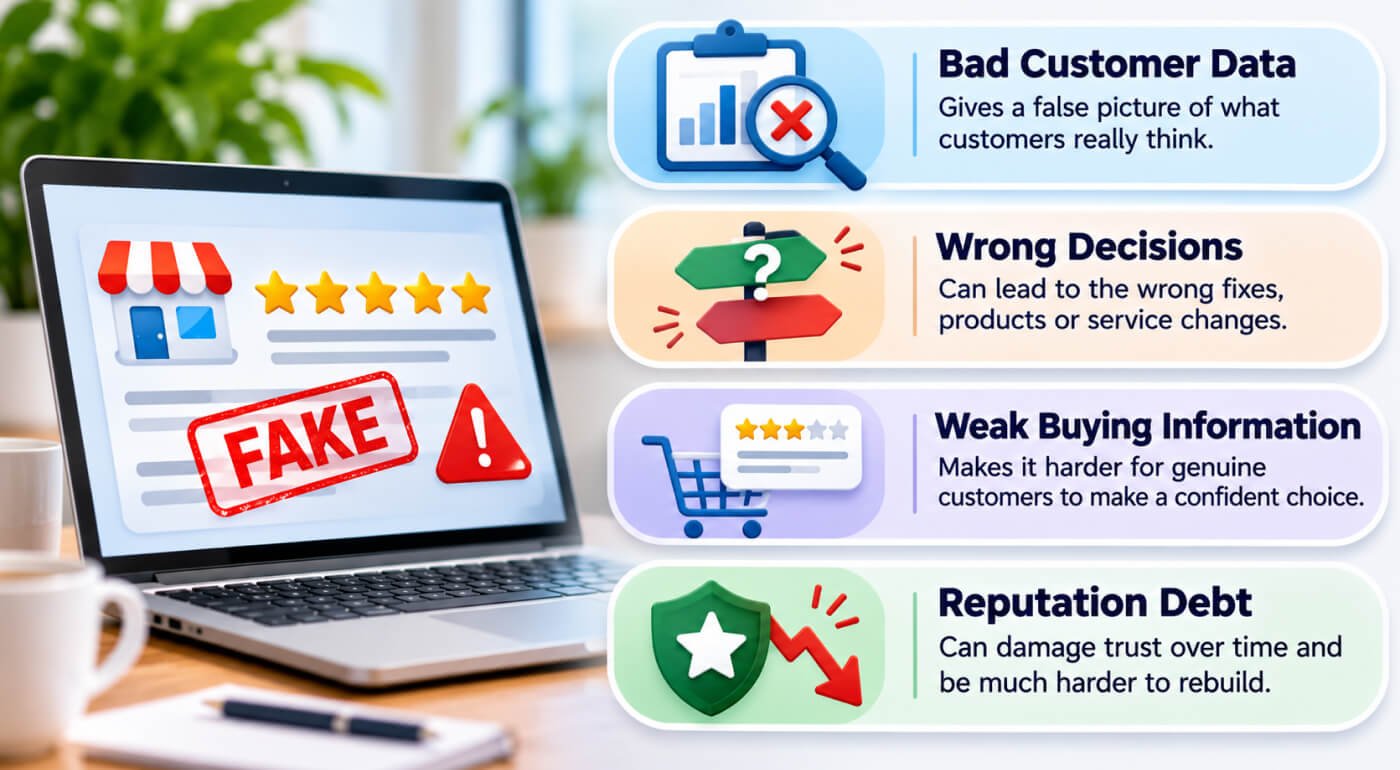
Fake reviews can damage the information a business uses to improve. This issue gets less attention than fines or profile limits. Yet a cleaner-looking rating can hide problems that real customers are trying to show you.
- Bad customer data: Fake praise can hide real service problems.
- Wrong decisions: Owners can improve things customers do not value.
- Weak buying information: Generic praise gives future customers little useful detail.
- Reputation debt: An artificial rating can create pressure to keep manipulating reviews.
Real criticism can help businesses fix their weak areas. If customers often mention slow replies or unclear prices, this can show a real problem. Fake five-star reviews can hide those warning signs. The business may then see a better score but understand its customers less. So, the review profile can look stronger while the real service stays the same.
That creates an awkward cycle. Real problems stay, while the public score moves away from the customer experience. Eventually, the gap can lead to more complaints. A genuine review system also gives you feedback that can improve the service itself.
How Can You Get Google Reviews Without Paying Reviewers?
The safest way to get more Google reviews is to ask real customers after they use your service. A simple system works best when the request is fair and easy to follow. The aim is not to push people to give five stars. Instead, the aim is to make honest feedback easy. Google also allows businesses to ask customers for genuine reviews.
- Choose a real trigger: Ask after a completed purchase, appointment, job, or support case.
- Ask customers fairly: Do not pres-select only people likely to leave five stars.
- Remove friction: Give customers a direct Google review link or QR code.
- Use a polite reminder: Send one sensible follow-up when the timing suits the customer.
- Measure the process: Track requests and completed reviews, not only five-star ratings.
Timing is normally more important than clever words. Customers remember the service best soon after it ends. A short message can thank them, ask for honest feedback and give one clear link. Do not ask for five stars or tell them what to say. This keeps the request fair and gives the customer full control.
Automation can help here. A CRM or review tool can send a request after payment or a completed appointment. That does not make the review fake. The problem starts when the system rewards reviews, filters unhappy customers or pushes a certain rating.
Then what does a business need to reach 500 Google reviews? There is no safe shortcut. It needs real customers and a regular way to ask for reviews. Over time, honest reviews can build up steadily. The total should match the number of real customers, not a number bought from a seller.
Want a better way to grow your Google reputation? Build a stronger Google Business Profile with practical review support from SMM Zone.
Is Google Customer Reviews the Same as Google Business Profile Reviews?
No. Google Customer Reviews and Google Business Profile reviews serve different purposes. Business Profile reviews appear with local businesses on Google Search and Maps. Google Customer Reviews is a Merchant Center programmer linked to online purchases and store ratings. It is not a route for buying Business Profile reviews.
This difference is important for e-commerce businesses. Verified buyers can choose to leave feedback through Google Customer Reviews. Local businesses should still use their Business Profile review link to ask for honest public reviews. Basically, the names sound similar but the two systems collect and show feedback in different places.
Final Thoughts: Can I Pay to Get Google Reviews?
So, can I pay to how to get Google reviews? You can pay for systems that help real customers share honest feedback. However, you should not pay for the review itself. Fake reviews, paid praise and reward-based reviews can create serious problems. For UK businesses, those problems can affect your profile, reputation and legal position.
A better way is to build trust one real review at a time. Ask real customers, keep the process simple and let them speak freely. Before you hire a review company, ask one clear question: do they collect real feedback or create it? Basically, the answer can tell you most of what you need to know.
FAQs About Can I Pay to Get Google Reviews
1. Can You Pay People to Give You Google Reviews?
- No. Google does not allow businesses to pay or reward people for leaving reviews. Paid reviews can count as fake engagement and may be removed.
2. Can Google Detect Fake Reviews?
- Yes, Google uses automated systems and other signals to find suspicious reviews. Unusual review patterns, fake accounts and manipulated activity can lead to review removal or profile restrictions.
3. Can I Pay for 5-Star Reviews on Google?
- No. Paying for 5-star Google reviews breaks Google’s review rules. Reviews should come from genuine customers who choose their own rating and wording.
4. How to Get 1000 Reviews on Google?
- There is no safe shortcut to 1,000 genuine Google reviews. Build a regular review request system and ask real customers after completed purchases, appointments or services.
5. Is It Possible to Generate Fake Google Reviews?
- Fake Google reviews can be created but using them can break Google’s policies and UK consumer rules. Google can remove suspicious reviews and take action against the Business Profile.
6. How Much Does It Cost to Get Google Reviews?
- Genuine Google reviews do not have a fixed price because customers leave them voluntarily. Businesses can pay for review-management tools or services but they should not pay customers for Google reviews.
