

Views: 0
One great review can change more than your star rating. It can shape trust, influence customer choice and change how your business looks beside competitors. Now you can ask, how much is a 5 star Google review worth? Actually, there is no fixed pound value. Its real worth depends on your current rating, review count, customer value and local competition.
For a small profile, one review can clearly change the average score. On a large profile, the rating may hardly move. However, the review can still add fresh proof and help customers choose. So, its real value comes from the change it creates.
Now, let’s dive deeper into this guide, which explains what gives a five-star Google review real business value. You will also see how ratings, review count, customer trust and local visibility can shape that value.
How Much Is a 5 Star Google Review Worth in Practice?
A five-star Google review has no fixed cash value in the UK. Its real worth depends on how it affects trust, your rating and customer choice. In practical terms, a review has influence value rather than guaranteed sale value. One review might lift a small profile towards a better score. However, one new rating on a large profile might change almost nothing. So, its value depends on what actually changes after the review appears.
UK consumer behavior shows why this matters. The Competition and Markets Authority says 89% of consumers use online reviews during product or service research. It also estimates that reviews can influence up to £23 billion of UK consumer spending each year. That still does not give one review a fixed price. Instead, a review becomes valuable when it affects trust, enquiries, customer choice or sales.
What Determines How Valuable a Five-Star Google Review Is?
A five-star Google review becomes more valuable when it makes a clear difference to your profile. Your current rating, review count, customer value, timing and local competition all shape that value. Generally, one new rating has more weight on a small profile. A review for a costly service can also carry more business value. That happens because one new customer can be worth far more to that business.
- Current rating: A five-star review can help a weaker average more.
- Review count: One new rating carries more weight on a small profile.
- Customer value: A £2,000 service has different economics from a £10 purchase.
- Local competition: Reviews matter more when nearby businesses look similar.
- Review recency: Fresh feedback shows customers what service looks like now.
- Review detail: Specific comments can answer common customer concerns.
- Rating movement: A review matters more near a visible score change.
Here is where it matters. Customers often judge the whole review profile, not one number. They can check the star score, review count, recent comments and written feedback together. Business replies can also show whether a company listens to customers. For this reason, review recency mainly works as a trust factor. It should not be treated as a confirmed ranking factor on its own.
Is a Perfect 5.0 Google Rating Always More Valuable?
Not always. A perfect score looks good, but customers also check review count and detail. For example, compare a business with 5.0 from seven reviews to one with 4.7 from 240 reviews. The second profile gives people far more feedback to read. Similarly, recent comments can answer questions that a star score cannot. So, a real and active review profile can matter more than simply keeping a perfect score.
How Can You Calculate Google Review ROI Without Guessing?
You can calculate Google review ROI by linking a stronger review profile to real business results. Focus on extra enquiries, customer conversions and contribution profit. Do not give one review a made-up cash value. A useful formula is estimated extra contribution = additional customers influenced × contribution profit per customer. For a lead-based business, use extra enquiries × conversion rate × contribution profit. In practice, contribution profit gives a clearer view than revenue because it shows what remains after direct costs.
Before you do the maths, gather numbers that describe your real business:
- Monthly local traffic: Count relevant people reaching your profile or website.
- Monthly enquiries: Track calls, forms, bookings and messages.
- Conversion rate: Measure how many enquiries become paying customers.
- Average sale value: Know what a normal customer spends.
- Contribution profit: Estimate what remains after direct costs.
- Repeat value: Check how often customers return.
- Review count: Record the size of your existing profile.
- Current rating: Note the score customers see now.
For example, imagine a UK service business gains six extra enquiries after its review profile improves. Half of those enquiries become customers. Each new customer creates £180 in contribution profit. The estimate becomes 6 × 50% × £180 = £540. Still, this does not prove one Google review created £540. It shows the possible effect of a stronger review profile while other business factors stay similar.
How Much Can One Five-Star Review Change Your Google Rating?
One five-star review can noticeably change your Google rating when you have fewer reviews. However, the effect becomes smaller as your review count grows. Google works out a Business Profile score from its published ratings. You can estimate your new score with (current rating × review count + 5) ÷ (review count + 1). Still, Google can show a rounded score. So, the result should always be treated as an estimate.
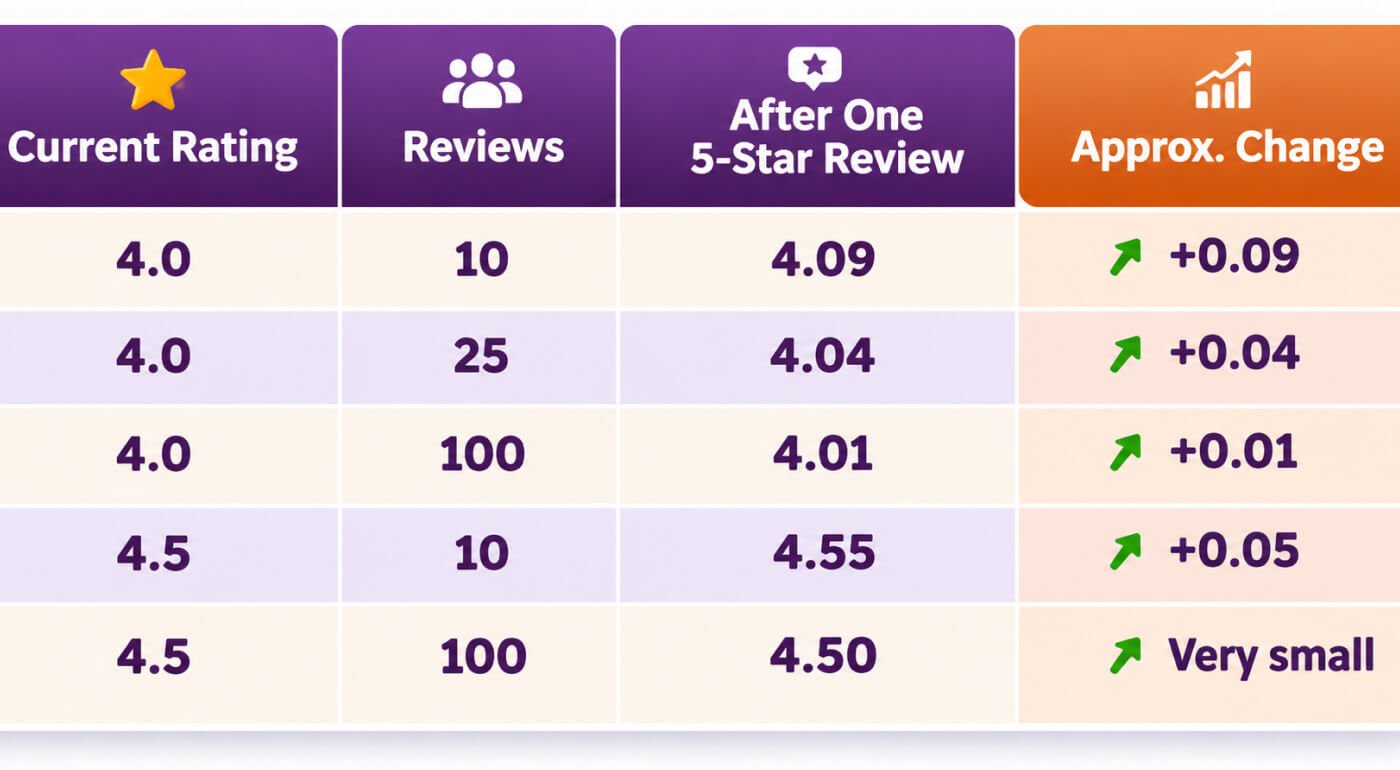
The table shows a clear pattern. One new five-star rating has more impact when only ten reviews exist. At 100 reviews, the same rating creates a much smaller change. This is often called diminishing impact. However, later reviews are not useless. Their value can shift towards fresh proof, trust, detail and the strength of the whole profile.
When Can One Five-Star Review Matter Most?
One five-star review matters most when it creates a clear change in your profile. This happens more often when you have fewer reviews. Each new rating then makes up a bigger part of the total. A review can also matter near a score change or during rating recovery. Similarly, fresh feedback can reassure customers when a profile has been quiet for some time.
- Few existing reviews: Each new rating forms a bigger part of the total.
- Near a score change: One review can move the average towards a new display.
- Recovering a weaker score: Strong feedback can improve the average over time.
- Close local competition: Small profile differences can affect customer choice.
- Little recent feedback: A new review gives customers fresher evidence.
None of these cases guarantees a ranking rise. For example, reaching 50, 100 or 500 reviews does not unlock a known Google reward. Instead, the next review has more practical value when it creates a clear difference. That change could affect the average score, customer trust or the amount of fresh feedback on the profile.
How Many Five-Star Reviews Do You Need to Reach a Target Rating?
You can estimate how many five-star reviews you need with a simple formula. Use reviews needed ≈ N × (target rating − current rating) ÷ (5 − target rating). Suppose you have 40 reviews at 4.2 stars and want to reach 4.5. The maths gives 40 × 0.3 ÷ 0.5 = 24. So, you would need about 24 new five-star ratings if no other reviews arrive.
Always round decimal results upwards because you cannot receive part of a review. Also, remember that your visible Google rating can already be rounded. Because of this, the real number can differ slightly. Google also says an updated review score can take up to two weeks after a new review appears. So, do not assume the maths is wrong if your displayed rating stays the same for several days.
Can Better Google Reviews Increase Sales and Revenue?
Yes, better Google reviews can help sales by building trust and guiding customer choice. However, one review cannot promise a set amount of money. Normally, the path is simple: reviews → trust → enquiry → customer → revenue. Reviews can also reduce doubt before someone calls, books or buys. So, their value becomes clearer when you link them with conversions, customer value and real business results.
UK evidence shows why this matters. The CMA says 89% of consumers use online reviews while researching products or services. It also estimates that UK consumers spend up to £23 billion each year on purchases that online reviews can influence. That does not mean reviews generate £23 billion themselves. Instead, they can play a part in buying choices linked to that level of spending.
Why Can a High-Value Service Gain More From Strong Reviews?
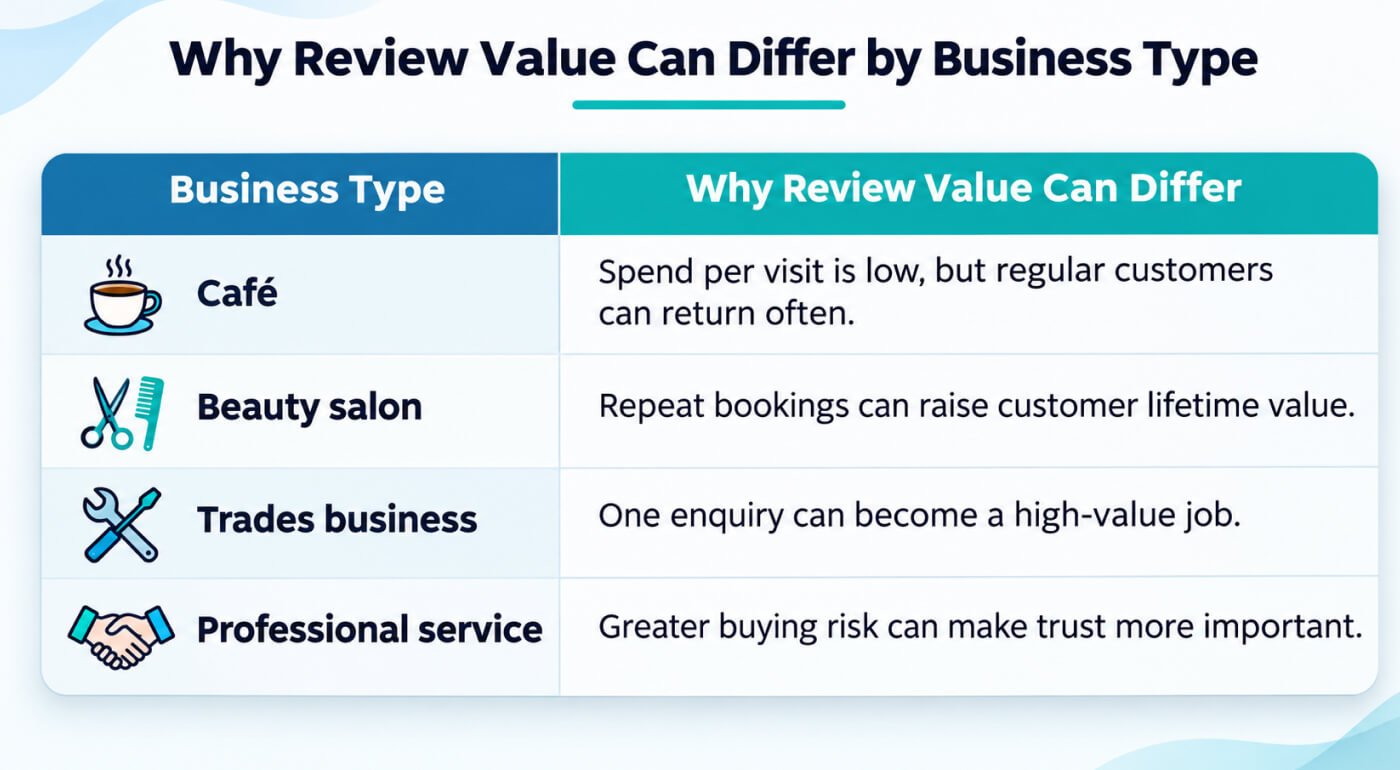
A high-value service can gain more from strong reviews because one new customer can be worth much more. A café customer might spend £6 during one visit. By comparison, a roofing or heating enquiry could lead to a job worth thousands. Similarly, people often want more proof before making an expensive choice. Reviews can reduce that doubt by showing how past customers felt about the service, work and support.
However, the review does not create the whole sale. Price, location, staff, timing, skill and competition also shape the final choice. For this reason, do not treat one review as the full value of a new job. Instead, see the review profile as one useful part of the wider buying journey.
Do Google Reviews Help Local SEO in the UK?
Yes. Google says positive ratings and more reviews can support local rankings. However, reviews are only one part of local search. Google mainly explains local results through relevance, distance and prominence. So, a strong review profile cannot always beat location or poor business details. Reviews support the wider profile. They do not act as a simple shortcut to the top of local results.
- Relevance: The profile should closely match what the customer searches for.
- Distance: Location affects which businesses appear for local searches.
- Prominence: Reviews and wider signals can show how established a business is.
Google does not publish a magic review number for the Local Pack. So, 100 reviews do not guarantee a top-three position. One new review also does not equal one ranking place. In practice, a stronger review profile can support trust and prominence. That can create more chances to win attention, clicks, calls or visits from people searching nearby.
Can Google Reviews Affect Local Services Ads?
Yes, for eligible UK service businesses. Google says star ratings and review numbers can affect ranking within Local Services Ads. Profile quality also looks at response time, business details, checks and other signals. Because of this, reviews can affect visibility beyond normal Maps results for some trades. However, Local Services Ads only work for supported business types and areas.
UK Local Services Ads support selected services such as electricians, cleaners, carpenters and HVAC businesses. Other approved categories are also available. So, a strong review profile can matter in more than one place. It can support local search and Local Services Ads. Still, reviews cannot replace relevance, response speed, service area, checks or the other factors Google uses.
Can a Bad Google Review Cost More Than a Five-Star Review Adds?
Yes, a bad Google review can hurt more when a business has very few reviews. Imagine ten five-star ratings with an average of 5.0. Add one one-star review and the average becomes (10 × 5 + 1) ÷ 11 = 4.64. That is a sharp drop from one rating. By contrast, the same one-star review would have much less effect on a profile with several hundred reviews.
But why can the damage feel bigger? A poor review can lower your rating and raise a concern at the same time. For example, a complaint about missed appointments can worry someone comparing two firms. So, the review can affect both the score and customer trust. Businesses should read the complaint, understand the problem and reply in a calm and helpful way.
How Can a Bad Review Hurt in Two Different Ways?
A bad review can hurt through rating impact and text impact. Rating impact changes the average score. Text impact changes how people feel about the business. Actually, a clear complaint about delays, poor work, safety or communication can have a strong effect. This can happen even when the overall star score barely changes because many reviews already exist on the profile.
For this reason, review management should not focus only on the average rating. The words inside reviews can answer questions before customers make contact. A calm reply can also show how the business handles problems. It cannot remove a real bad experience but it can give useful context to people who read that review later.
Why Should UK Businesses Avoid Fake or Gated Five-Star Reviews?
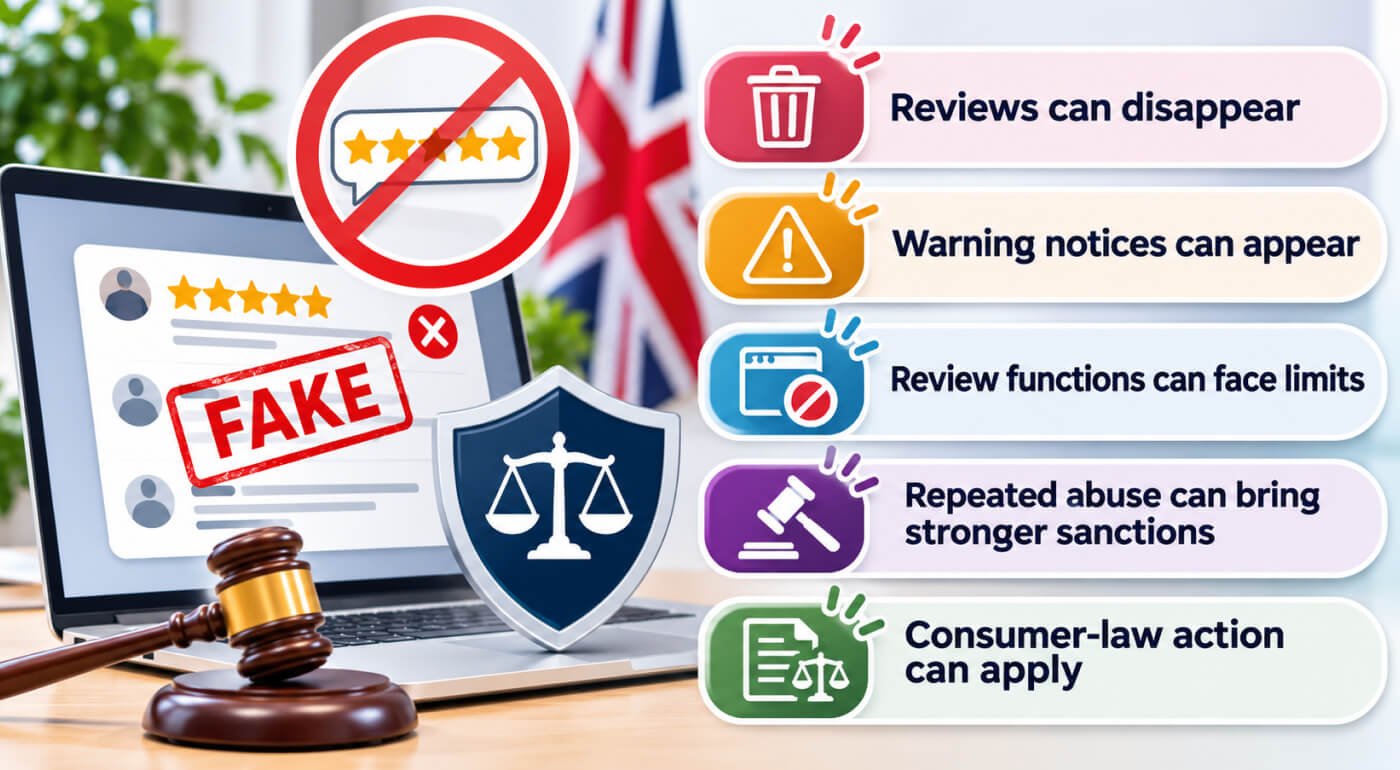
UK businesses should avoid fake or gated five-star reviews because they can cause legal, platform and trust problems. Since 6 April 2025, updated UK consumer rules have covered fake-review practices more clearly. The law bans certain fake and misleading review activity. The CMA also has stronger powers to take direct action. Google also bans paid reviews, false reviews and rating manipulation. So, buying five-star reviews can create far more risk than value.
- Reviews can disappear: Google can remove content that breaks its rules.
- Warning notices can appear: Suspicious activity can lead to visible warnings.
- Review functions can face limits: Serious abuse can lead to restrictions.
- Repeated abuse can bring stronger sanctions: Action can increase after repeat problems.
- Consumer-law action can apply: Serious breaches can lead to large fines.
The CMA can give major penalties for serious breaches under the newer UK system. A business can face a fine of up to 10% of global turnover. However, that does not mean every fake review leads to a 10% fine. The level depends on the case and legal breach. Google has also agreed to stronger action against UK businesses linked with fake review activity.
What Is Review Gating?
Review gating means sending happy customers towards public reviews while directing unhappy customers elsewhere. Google does not allow businesses to block negative reviews or ask only people likely to leave positive ratings. It also bans rewards such as discounts, free items or payments for reviews. So, a business should ask real customers for honest feedback without telling them what score to give.
This creates a more natural review profile and lowers policy risk. Similarly, staff should not pressure customers when asking for feedback. An honest mix of real reviews gives future customers a clearer picture. Because of this, genuine feedback can build trust over time. It works far better than trying to protect a perfect five-star score.
Want stronger trust when customers find you on Google? Discover SMMWise while keeping every review activity aligned with Google policies.
How Should You Measure the Real Value of Your Google Reviews?
You should measure the real value of how to get Google Reviews by comparing them with your own business results. Start with a clear baseline before deciding that stronger reviews improved performance. Track your rating, review count, enquiries, conversions, customer value and profit over time. Similarly, watch nearby competitors because customers often compare several businesses at once. Without a baseline, a normal rise in demand can easily look like a review-driven gain.
Useful numbers to track are:
- Current rating: Record the score customers see.
- Total reviews: Watch how the review base grows.
- New reviews: Track how much fresh feedback arrives.
- Calls and enquiries: Measure changes in customer contact.
- Website leads: Compare local traffic and conversions.
- Customer value: Track average spend and contribution profit.
- Repeat value: Measure the value of returning customers.
- Competitors: Compare nearby ratings and review counts.
Then compare similar periods. For example, look at performance before and after moving from 4.1 to 4.3. You could also compare results as review count moves from 38 to 70. However, seasonality matters. A roofer should not compare a quiet winter month with a busy summer month. The aim is not to prove one review caused one sale. Instead, look for a clear link between stronger reviews and better business results.
Final Thoughts on How Much Is a 5 Star Google Review Worth?
So, how much is a 5 star buy Google reviews UK worth when you look at the bigger picture? There is no single pound figure. Its real value comes from the change it creates across trust, customer choice, conversions, visibility and business results. What matters most is whether the review helps a real customer feel more confident about choosing you.
That is why one review should never be judged by price alone. Instead, track what happens to your rating, enquiries, conversions and customer value over time. This gives you a clearer view of Google review ROI. More importantly, it shows when genuine reviews are turning online trust into real business value.
FAQs About How Much Is a 5 Star Google Review Worth
1. Can One Five-Star Review Change a 4.4 Rating to 4.5?
- Yes, it can but the result depends on your current review count and exact average. A small profile usually moves faster because each new rating carries more weight.
2. Do Google Reviews Without Written Text Still Count?
- Yes. A star-only review still counts towards your overall Google review score. However, written reviews can give customers more detail about your service and experience.
3. Is a Perfect 5.0 Google Rating Always Better?
- Not always. Customers can also look at review count, recent feedback, detail and overall trust. A strong profile with many genuine reviews can feel more useful than a perfect score with very few reviews.
4. Do Replies to Google Reviews Improve Local Rankings?
- Google does not promise that replying to reviews will directly improve your ranking. However, helpful replies can show that your business cares about customer feedback. They can also show that your business is active and listens to customers.
5. Can You Ask Customers to Leave Five-Star Google Reviews?
- You can ask genuine customers to leave an honest Google review. However, you should not pressure them to give five stars or ask only customers likely to leave positive feedback.
