
Views: 1
A five-star boost can look like an easy win. At first, the higher rating can make your business seem more trusted. The problem often starts later, when reviews disappear or Google takes a closer look at the profile. That is where buy Google reviews UK becomes more complicated than it first appears.
Businesses often want to build trust faster when real reviews grow slowly. Paid reviews can make the numbers look higher. However, they may not give lasting value. In practice, Google can remove paid reviews. It can also limit profiles linked to fake review activity. At the same time, UK rules have become stricter since April 2025.
Now, let’s break down what happens before and after you buy reviews, including the risks sellers often leave out.
What Should You Check Before You Buy Google Reviews UK?
Before you buy reviews for Google, look beyond the price. Cost matters but it tells you little about review quality or long-term value. Instead, compare what each package actually offers and what those claims really mean.
Sellers usually compete on a few clear points:
- Price and minimum order: Check the full cost and number of reviews required.
- UK targeting: Ask what the seller really means by UK-based accounts.
- Account claims: Some sellers promote old profiles, Local Guides or local-looking accounts.
- Delivery method: Packages can offer slow posting and custom review text.
- Protection terms: Sellers can offer replacements, refunds, tracking or support.
However, these are only seller features. They do not prove that a real customer used the business. An old account can still post a fake review. Similarly, a Local Guide badge does not prove a real purchase.
UK-looking profile details don’t prove the person used your business either. Slow delivery also cannot turn a fake review into a genuine one. Google requires reviews to reflect real experiences and bans paid reviews.
In practice, check the package terms before you pay. A cheap package may have poor refund rules. A costly package may only give longer replacement cover. However, the price does not prove that a review comes from a real customer.
Why Do Bought Google Reviews Disappear?
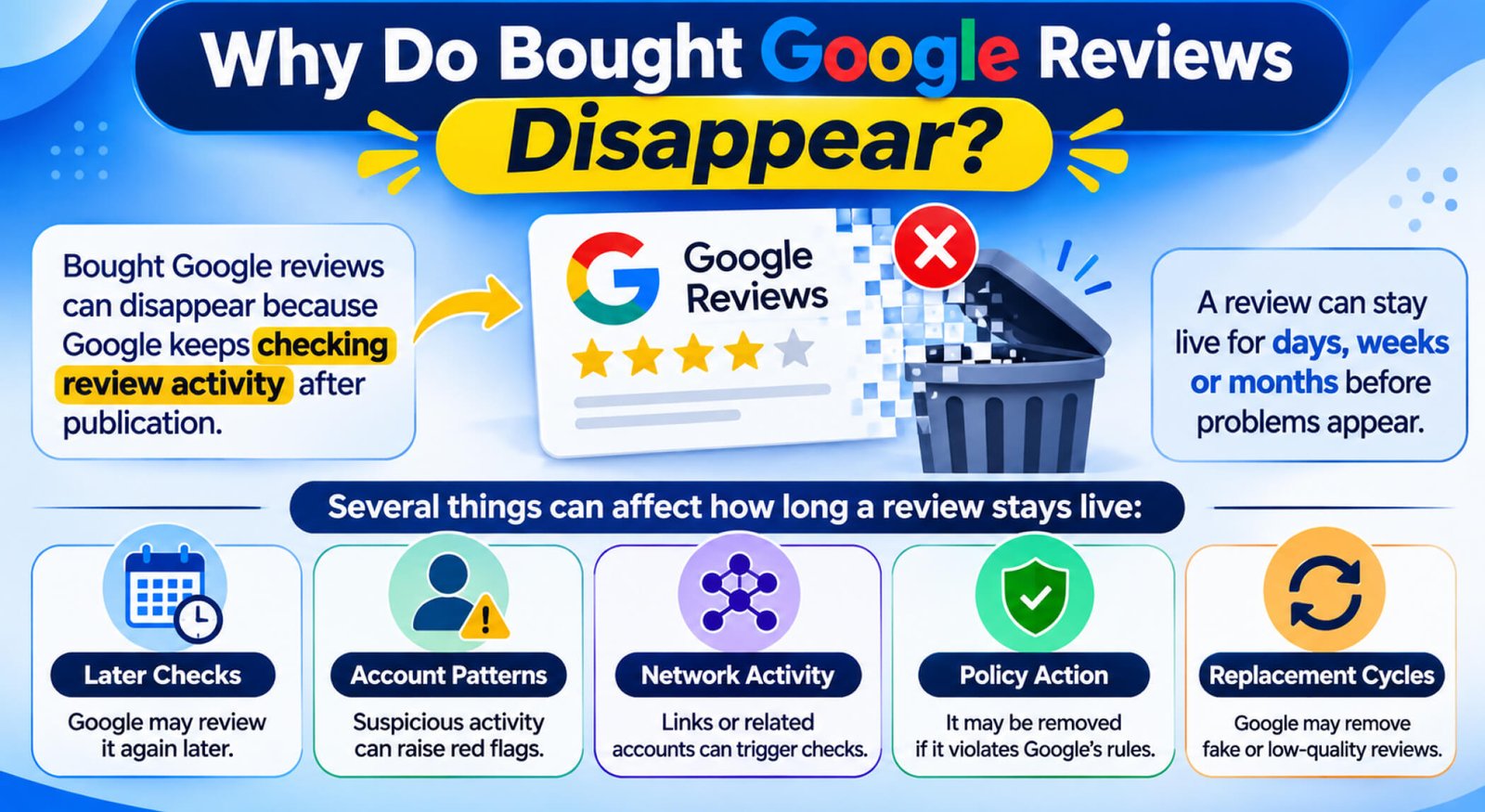
Bought Google reviews can disappear because Google keeps checking review activity after publication. A review can stay live for days, weeks or months before problems appear. That can make the service look safer than it really is.
Several things can affect how long a review stays live:
- Later checks: Google can review content again after it appears.
- Account patterns: A reviewer account can show risky behaviour over time.
- Network activity: The same accounts can appear across many unrelated businesses.
- Policy action: Google can remove reviews that break its rules.
- Replacement cycles: A replacement can later face the same problem.
Google can find new abuse patterns after reviews go live. So, a review can look normal at first and cause problems later. A seller cannot control Google’s review systems or future checks.
Still, a missing review is not always fake. Genuine reviews can sometimes take time to appear. Profile changes can also cause delays. In some cases, a real review can disappear by mistake.
So what does a replacement guarantee really protect? Normally, it covers the seller’s promise to replace a missing review. It does not guarantee Google approval, ranking stability or profile safety. A replacement can face the same problem later.
Do Bought Reviews Really Help Local SEO?
Bought reviews can change the numbers you see. However, they do not always improve local SEO. Google says local results mainly depend on relevance, distance and prominence. Reviews can help with prominence. So, real review growth can also help your local visibility.
Google also says more reviews and good ratings can help local ranking. However, reviews are only one part of local search. A high number of reviews cannot fix every problem on a Business Profile. Still, buying Google reviews uk can make the review count and average rating look higher. But this gain can disappear if Google removes those reviews.
Take a simple example. A business has 40 reviews with a 4.1 rating. Then, 20 new five-star reviews appear. The average rating goes up to about 4.4. However, if those 20 reviews later disappear, the rating drops again. So, the business loses that extra gain. This is why review numbers alone can make progress look better than it really is.
A business can also have deeper local SEO problems. It can use the wrong category or weak profile details. Similarly, the searcher can simply be too far from the business. Google calculates its visible score from published ratings. New ratings can also take time to affect that score. So, a quick change does not prove a lasting SEO win.
Some SEO articles make stronger claims about review speed or keywords inside reviews. Google does not publish exact weights for those ideas. Treat them as SEO theory, not confirmed ranking rules.
What Happens When You Stop Buying Reviews?
When you stop buying reviews, the biggest problem is reputation debt. This happens when fake growth creates numbers that real customers cannot keep up with. As a result, normal review growth may suddenly look weak.
Imagine a business buys 30 reviews this month. The next month, it gets only two real reviews. Then, the month after that, it gets just one. Now the big rise from before becomes the new level to match. So, the owner may feel pressure to buy reviews again. A quick shortcut can soon become a regular cost.
Actually, the cost is not only money. Fake growth can create a public image that real customer activity cannot support. It can also make future genuine growth look unusually slow.
A healthy reputation works differently. Real customers keep adding feedback as the business serves more people. Growth can be slower but it reflects real demand.
Can Customers Spot Purchased Reviews?
Yes, customers can sometimes spot bought reviews by checking the words and the reviewer’s profile. They do not need special tools. Instead, they may see words or patterns that appear again and again.
Suspicious reviews can use vague praise or very similar wording. Reviewer profiles can also show odd location patterns. Some accounts can leave many five-star reviews for unrelated businesses.
But why does this matter if Google leaves the review online? Trust can fall before any platform action happens. A customer can see a high score and still doubt the profile.
In a similar way, too many generic comments can weaken trust. Real reviews often mention small details about service, staff, timing or products. Fake-looking reviews often say very little.
The key point is simple. A review does not need deletion before it causes harm. If customers distrust the profile, the higher rating loses value.
What Can Google Do to Your Profile?
Google can do more than remove individual fake reviews. If it finds fake engagement, it can place wider limits on the whole Business Profile. These actions can affect reviews, ratings and customer trust.
Google can stop a profile from getting new ratings for a set time. It can also hide existing ratings for a set period. In some cases, customers can see a warning about removed fake reviews.
That difference matters. Review-level action affects individual reviews. Profile-level action affects the wider Business Profile and its review activity.
Google has also increased its work against fake reviews. In 2025, it blocked or removed over 292 million policy-breaking reviews. It also limited posting on more than 782,000 accounts.
So, this is not only a manual review process. Google checks review activity at a very large scale. A business cannot assume fake reviews will always remain unnoticed.
UK regulators have also pushed Google to act against fake review abuse. Google agreed to stronger action against UK businesses using fake reviews. Warning notices were part of those changes.
What Access Should You Never Share?
Never give a review seller more access than they truly need. Your password, security codes and primary ownership should stay under your control. This matters just as much as price or delivery.
Protect these areas:
- Your Google password: Do not share the main login for your account.
- OTP or PIN codes: Never share security or verification codes.
- Primary ownership: Keep control of your Business Profile.
- Unknown manager access: Approve only people you know and trust.
- Customer data: Do not share private customer records without a real need.
Google warns businesses about unknown access requests. It also says it will never ask for your OTP or PIN. Those details should always stay private.
Practically, this matters even more for agencies and multi-location brands. One weak access process can affect several profiles. Central access rules can reduce that risk.
What If Fake Reviews Target Your Business?
If fake reviews target your business, do not reply with more fake reviews. This can create another problem instead of fixing the first one. Instead, save the proof and report the reviews to Google in the right way.
Use a simple response plan:
- Do not buy positive reviews: Avoid creating a second fake review problem.
- Save evidence: Keep review links, screenshots, dates and messages.
- Report fake reviews: Use Google’s normal review reporting tools.
- Use the extortion route: Choose this when someone demands money.
- Do not pay attackers: Payment does not guarantee review removal.
Review extortion can involve bad reviews followed by demands for money, goods or services. Practically, keep clear proof of what happened. Save messages, review links and any payment demand.
Ordinary fake reviews and review extortion are not the same problem. They need different reporting routes. So, identify what happened before you act.
Which Review Tactics Still Break the Rules?
Some review tactics can break the rules even when you never buy reviews. Review gating, rewards, staff pressure and conflict reviews can all create problems. Businesses sometimes use these methods without realising the risk.
Review gating is one example. This happens when a business asks only happy customers for public reviews. Unhappy customers get filtered away from Google. Rewards can also create problems. Money, discounts, free goods or free services can affect how genuine feedback appears. Ask for honest feedback without trying to control the rating.
Staff pressure can cross the line too. Businesses should not force workers to collect a fixed number of reviews. They also should not tell customers what wording to use. Conflict reviews create another risk. Employees or linked people should not pose as normal customers. Family members should not leave false customer feedback either.
UK law and Google policy are linked but they are not the same thing. UK rules ban fake reviews and reviews that hide an incentive. Google also has its own platform rules.
The UK rules took effect on 6 April 2025. CMA guidance also tells businesses not to hire others to write fake reviews. That rule can apply to agencies working for clients too.
What If You Already Bought Google Reviews?
If you already bought Google reviews UK, stop the activity before it creates more risk. Then check which third parties still have access to your Business Profile and review systems. Stop buying more reviews and remove reward-based campaigns. Check which third parties can manage your Business Profile. Remove access that no longer has a clear business need.
Similarly, review staff scripts and automatic messages. Make sure they ask real customers for honest feedback. Stop review gating if your process filters unhappy customers away.
Also watch your Business Profile emails and review activity. Google sends notices when some profile limits apply. Businesses can challenge restrictions they believe were applied by mistake.
But what should you avoid? Do not try to hide old activity with more fake reviews. That only creates a larger problem and more risk.
How to Get Google Reviews Without Buying Them?
The best way to get Google reviews without buying them is to make honest feedback easy for real customers. A simple process should fit naturally into normal customer service. It should not push people towards a certain rating.
A practical system can work like this:
- Ask after real interactions: Choose a sensible point after a service or purchase.
- Share a direct review link: Remove extra steps from the process.
- Use QR or NFC tools: Place them where customers can use them easily.
- Ask neutrally: Request honest feedback instead of five-star ratings.
- Build a routine: Use email, SMS or post-service messages in a steady way.
Timing should match the business. A tradesperson can ask after finishing the job. A retailer can ask after the customer completes a purchase. In the same way, a restaurant can ask after the visit. A professional service can ask after a clear service milestone. A healthcare business should choose a safe and suitable point.
NFC review cards can also reduce effort. A customer taps the card and reaches the review page faster. Still, the card does not create a good review by itself.
For a strong Google review UK process, keep every request neutral. Genuine customers should choose the rating, wording and final decision. That protects trust and keeps the process simple.
What Rules Apply in the UK?
Buying Google reviews in the UK can cause legal problems. This is because fake review practices are now clearly banned. From 6 April 2025, UK consumer rules cover fake reviews. They also cover paid reviews that are not clearly shown as paid.
The CMA guidance also tells businesses not to write fake reviews. Businesses should not pay or ask other people to write them either. Also, agencies can face problems if they arrange fake review work for clients.
Businesses using misleading review practices can face serious action. CMA guidance says fines can reach 10% of global turnover. Some cases can also lead to criminal action. The CMA opened five review-related investigations in March 2026. Those cases cover several sectors and review practices. An investigation does not prove that a business broke the law.
Basically, Google policy and UK law create separate risks. A tactic can break Google’s rules before a regulator gets involved. So, businesses need to consider both.
Final Thoughts: Should You Buy Google Reviews UK?
If you buy Google reviews UK, the numbers can go up fast. However, that trust does not come from real customers. If those reviews disappear, the profile may lose the strength it seemed to have.
A better goal is to build review equity. This means earning trust from real customer experiences. Over time, that trust can grow with the business. The progress may feel slower, but it is based on something real.
In real terms, this gives your profile a stronger base. You do not need to depend on seller accounts or fake review bursts. Instead, your business grows its reputation through real customer feedback. That is the main difference. Bought reviews may increase the numbers. However, real reviews help build a stronger reputation.
FAQs About Buy Google Reviews UK
1. Can I Buy Good Google Reviews?
You can find services that sell Google reviews. However, paid reviews break Google’s rules. Google says reviews must come from real customer experiences. So, Google may remove reviews that people paid for.
2. Can I Pay to Get Google Reviews?
No, you should not pay customers or third parties for Google reviews. Google bans reviews exchanged for money, discounts, free products or other rewards.
3. How Much Is One Google Review Worth?
There is no fixed cash value for one Google review. Its value depends on your industry, location, competition and how genuine customers respond to your overall review profile.
4. How to Get 500 Google Reviews?
To reach 500 Google reviews, ask real customers for honest feedback. You can use a direct review link or a QR code. Ask after a real customer visit or service. Also, keep doing this in the same way over time.
5. Can Google Detect Fake Reviews?
Yes, Google uses people and smart systems to find fake reviews. It can remove reviews that look false or misleading. Also, Google may limit profiles linked to fake review activity.
6. How to Get 1000 Google Reviews?
Getting 1,000 Google reviews usually requires a large number of genuine customer interactions over time. Ask customers consistently through review links, QR codes, email or other suitable follow-ups without offering rewards.
7. How Can I Get Free Google Reviews?
You can get Google reviews for free by asking real customers for honest feedback. Also, Google lets businesses create a free review link or QR code. Customers can then use it to leave a review.
